What is the Gravitational Force?
The universe has a lot of forces, a lot of pushes and pulls. We're always pushing or pulling something, even if only the ground. But it turns out that in physics, there are really only four fundamental forces from which everything else is derived: the strong force, the weak force, the electromagnetic force, and the gravitational force.
The gravitational force is a force that attracts any two objects with mass. We call the gravitational force attractive because it always tries to pull masses together, it never pushes them apart. In fact, every object, including you, is pulling on every other object in the entire universe! This is called Newton's Universal Law of Gravitation. Admittedly, you don't have a very large mass and so, you're not pulling on those other objects much. And objects that are really far apart from each other don't pull on each other noticeably either. But the force is there and we can calculate it.
Equation
This equation describes the force between any two objects in the universe:
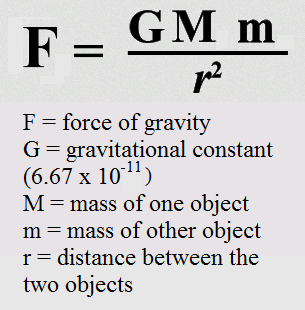 |
In the equation:
- F is the force of gravity (measured in Newtons, N)
- G is the gravitational constant of the universe and is always the same number
- M is the mass of one object (measured in kilograms, kg)
- m is the mass of the other object (measured in kilograms, kg)
- r is the distance those objects are apart (measured in meters, m)
So if you know how massive two objects are and how far they are apart, you can figure out the force between them.
Inverse Square Law
Notice that the distance (r) on the bottom of the equation is squared. This makes it an inverse square law. Because of this, if you double the distance between two objects, you reduce the gravitational force between them to a quarter of what it was. Or if you triple the distance between them, you reduce the force to a ninth of what it was. Or if we go the other way, halving the distance between two objects multiplies the force by a factor of four. This can be used to make rough comparisons between situations.
AN EXTRA APPROACH
AGAR YAHA TAK KAFI HO TO YAHI TAK LIKHIYO NAHI TO AAGE KO BHI CHHAP DIYO
Newton’s Law of Universal Gravitation is used to explain gravitational force. This law states that every massive particle in the universe attracts every other massive particle with a force which is directly proportional to the product of their masses and inversely proportional to the square of the distance between them. This general, physical law was derived from observations made by induction. Another way, more modern, way to state the law is: ‘every point mass attracts every single other point mass by a force pointing along the line intersecting both points. The force is proportional to the product of the two masses and inversely proportional to the square of the distance between the point masses’.
Gravitational force surrounds us. It is what decides how much we weigh and how far a basketball will travel when thrown before it returns to the surface. The gravitational force on Earth is equal to the force the Earth exerts on you. At rest, on or near the surface of the Earth, the gravitational force equals your weight. On a different astronomical body like Venus or the Moon, the acceleration of gravity is different than on Earth, so if you were to stand on a scale, it would show you that you weigh a different amount than on Earth.
When two objects are gravitational locked, their gravitational force is centered in an area that is not at the center of either object, but at the barycenter of the system. The principle is similar to that of a see-saw. If two people of very different weights sit on opposite sides of the balance point, the heavier one must sit closer to the balance point so that they can equalize each others mass. For instance, if the heavier person weighs twice as much as the lighter one, they must sit at only half the distance from the fulcrum. The balance point is the center of mass of the see-saw, just as the barycenter is the balance point of the Earth-Moon system. This point that actually moves around the Sun in the orbit of the Earth, while the Earth and Moon each move around the barycenter, in their orbits.

No comments:
Post a Comment